Category: Thought of the Day

A daily reflection from ScriptHaven designed to bring clarity, faith, and practical wisdom into ordinary life.

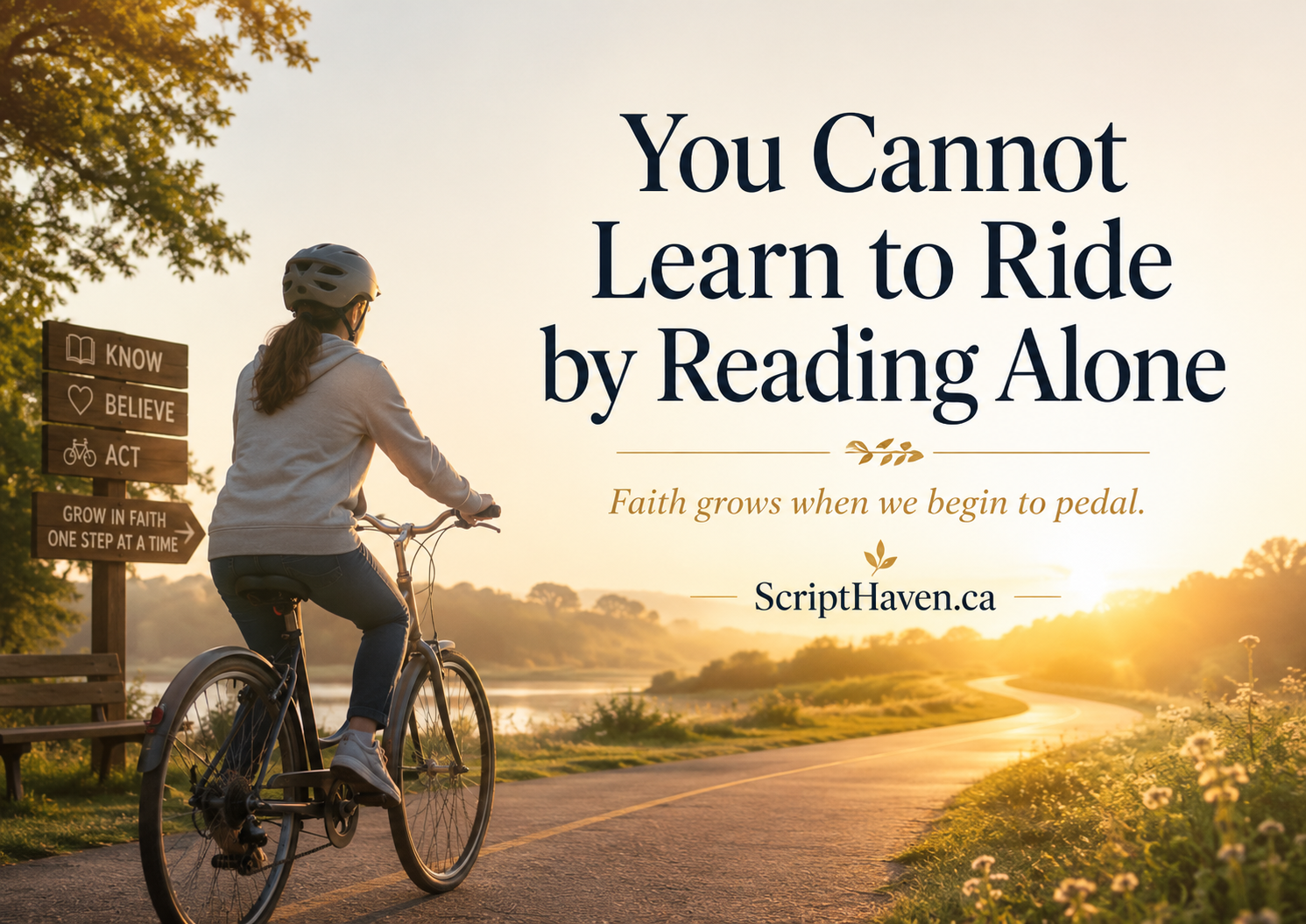
  • You Cannot Learn to Ride by Reading Alone

    You Cannot Learn to Ride by Reading Alone

    Inspiration1

    You can read every book ever written about riding a bike.

    You can watch every tutorial.
    You can study balance, steering, braking, posture, momentum, and pedal pressure.
    You can memorize diagrams, compare bicycles, listen to experts, and understand the theory perfectly.

    But until you sit on the bike, place your feet on the pedals, wobble a little, push forward, and actually try to ride—

    You are still standing beside the bike.

    Knowledge can prepare you.
    Instructions can encourage you.
    Wisdom can guide you.

    But movement changes you.

    Faith works the same way.

    We can read about prayer.
    We can talk about God.
    We can believe that Heavenly Father loves us.
    We can know, somewhere deep inside, that we should bring Him into our lives.

    But nothing truly begins to change until we speak to Him honestly, invite Him in sincerely, and take one small faithful action forward.

    A bike does not move because we understand it.

    It moves because we pedal.

    A life of faith does not grow simply by admiring belief from a distance.

    It grows because we practice walking with God.


    Premise

    There is a difference between knowing about faith and living in faith.

    Many people remain stuck because they are waiting to feel ready before they begin. They want perfect words before they pray. They want certainty before they act. They want confidence before they move.

    But life rarely gives confidence before action. More often, confidence is the fruit that grows after repeated small attempts.

    When a child learns to ride a bike, wobbling is not failure. It is part of the learning balance.

    In the same way, awkward prayers are not failed prayers. Quiet prayers, uncertain prayers, whispered prayers, and prayers that say, “Heavenly Father, I do not even know what to say” can still be sacred.

    God is not waiting for a polished speech.

    He is listening for a willing heart.


    Scripture

    James 2:17 teaches that faith without works is dead. Faith is not merely something we hold in our minds; it is something we begin to live through our choices.

    Proverbs 3:5–6 reminds us to trust in the Lord and acknowledge Him in all our ways. That phrase matters: all our ways. Not only the church. Not only a crisis. Not only on Sunday. All our ways.

    Matthew 7:7 teaches, “Ask, and it shall be given you; seek, and ye shall find; knock, and it shall be opened unto you.” Notice the movement in those words: ask, seek, knock. Faith has verbs.

    From the Book of Mormon, Ether 12:27 teaches that weakness can become strength through humility and grace. That means even our spiritual wobbling can become part of the training, not proof that we should quit.


    Discussion

    The mistake many of us make is believing we must become spiritually impressive before we approach God.

    That is backwards.

    We do not come to Heavenly Father because we have mastered life.
    We come because we need help learning how to live it.

    Prayer does not need to sound grand. It needs to be real.

    Try conversations like these:

    Morning Prayer
    “Heavenly Father, please walk with me today. Help me notice what matters. Help me speak with kindness, work with focus, and choose what is right even when it is inconvenient.”

    Before a difficult conversation
    “Heavenly Father, help me listen before I defend myself. Help me speak truth without pride and show respect even if I disagree.”

    When you feel distracted or overwhelmed
    “Heavenly Father, please help me return to what matters. Give me clarity, calm, and the courage to take the next small step.”

    When you make a mistake
    “Heavenly Father, I didn’t do well today. Please help me learn from this experience without being crushed by it. Show me what to repair, what to release, and how to begin again.”

    When you feel grateful
    “Heavenly Father, thank You for this moment. Help me not rush past the blessings that are already here.”

    These are not magic words. They are starting points.

    The point is not to pray perfectly.

    The point is to begin pedalling.


    Practical Application

    Bringing God into every aspect of life does not mean becoming loud, performative, or overly religious in every conversation.

    It means becoming aware.

    It means asking:

    • “Heavenly Father, how should I handle this?”
    • “What would love require here?”
    • “What is the honest thing to do?”
    • “Where am I being guided?”
    • “What small step of faith can I take next?”

    Faith becomes real when it enters the calendar, the inbox, the kitchen table, the workplace, the family conversation, the private decision, and the quiet moment when nobody is watching.

    That is where spiritual growth becomes practical.

    Not in theory.

    In motion.


    Prayer

    Heavenly Father,

    Please help me stop standing beside the life. You are inviting me to live.

    Help me move from knowing to doing, from wishing to walking, from fear to faithful action.

    Teach me to pray honestly, even when my words are imperfect. Help me bring You into my mornings, my work, my relationships, my decisions, and my private thoughts.

    When I wobble, help me not quit.
    When I fall, help me rise with humility.
    When I am unsure, help me take the next small step.

    Guide me gently. Strengthen me patiently. Teach me to trust you, not only in the big moments but also in the ordinary ones, too.

    In the name of Jesus Christ, amen.


    Call to Action

    Today, take one small consistent step toward bringing God into every part of your life.

    Choose one simple action and do it today:

    Before you start your day, say a one-minute prayer.
    Before you open your phone, ask God to guide your attention.
    Before you tackle a difficult task, remember to ask for focus and courage.
    When you feel frustrated, take a moment to pause and seek his wisdom before responding.

    Before bed: name one blessing and one lesson from the day.

    Do not try to spiritually “ride across the country” today.

    Just get on the bike.

    Pedal once.

    Then again tomorrow.

    Consistency is where faith becomes strength.


    Gratitude

    Today, appreciate the kindness of small beginnings.

    God does not despise the first wobbly attempt. He sees the heart that is trying. Every sincere prayer, every honest correction, and every quiet act of trust is part of learning balance.


    Closing Thought

    You cannot learn to ride a bike by standing beside it forever.

    And you cannot fully experience a life with God by only thinking about faith from a distance.

    At some point, love asks us to move.

    So pray simply.
    Act humbly.
    Begin again.

    The road will teach you valuable lessons as you ride.

    ScriptHaven.ca

    “A bike does not move because we understand it. It moves because we pedal it.”
  • The Forest He Could Not See

    ScriptHaven Thought of the Day — TOD-2026-0001

    The Forest He Could Not See

    Date Created: Monday, May 11, 2026
    One-Line Gist: A person may possess every resource required for warmth and still remain cold if they have never learned how to recognize possibility.
    Tags: Perspective, Neuroplasticity, Agency, Compassion, Resourcefulness, Hope, Faith in Action, Personal Growth


    Introduction

    Some people are not cold because they lack wood.

    They are cold because no one has helped them understand how warmth is made.

    Today’s ScriptHaven Thought of the Day reflects on perspective, compassion, neuroplasticity, faith, and the quiet power of beginning with what is already in our hands.


    Inspiration

    There are people you could leave with chopped firewood, a stone circle, dry matches, and an axe, yet they would still shiver through the night.

    Not because they are foolish.
    Not because they are lazy.
    Not because they are beyond help.

    But because somewhere along the road, they may have learned to see only lack, even while standing in the middle of provision.

    And there are others to whom you could give a whole forest, and they would still see only trees.

    Not lumber.
    Not shelter.
    Not a neighbourhood.
    Not a school.
    Not a gathering place.
    Not families laughing around winter windows.
    Not the beautiful civilization hiding inside raw material.

    The question, then, is not simply:

    Can we give people more wood?

    The deeper question is:

    Can we help people learn how to see fire?


    The Modern Parable: The Man with the Forest and No Fire

    There was once a man named Elias who inherited an old piece of land from his grandfather.

    It was not perfect land. The fence leaned. The shed door creaked in the wind. The cabin had a stove that looked as though it had survived three wars and one disastrous renovation.

    But behind the cabin stood a magnificent stretch of forest: spruce, pine, birch, and poplar rising like quiet witnesses.

    His grandfather had left him everything he needed.

    There was chopped firewood stacked against the shed.
    There was an axe hanging on the wall.
    There was a tin box of matches on the mantel.
    There was a stone circle outside where fires had been made for years.

    There was even a handwritten note that said:

    “There is enough here. Begin with what is in your hands.”

    But on the first cold night, Elias sat in the cabin wrapped in a blanket, trembling.

    He stared at the stove and whispered:

    “I have nothing.”

    The next morning, his neighbour, Mara, came by carrying a small loaf of bread.

    She saw the woodpile.
    She saw the axe.
    She saw the matches.
    She saw the stove.

    Then she saw Elias, exhausted and embarrassed.

    “You were cold last night,” she said.

    “I had no way to get warm,” he replied.

    Mara did not mock him. She did not lecture him. She did not say the obvious thing in a cruel voice, which is often how small people try to feel wise.

    Instead, she picked up one piece of kindling and placed it in his hand.

    “This is not a forest,” she said. “This is the first step.”

    Then she picked up a match.

    “This is not a miracle,” she said. “This is ignition.”

    Then she pointed to the stove.

    “This is not decoration,” she said. “This is a design waiting to be used.”

    Elias looked at the objects again, but this time not as scattered things around him.

    He saw them as a system.

    Wood.
    Match.
    Stove.
    Air.
    Attention.
    Action.

    By evening, the cabin was warm.

    Weeks passed.

    One morning, Mara found Elias standing outside, looking at the forest.

    “There are many trees,” he said.

    Mara smiled.

    “That is one way to see it.”

    “What else is there?” he asked.

    She pointed beyond the ridge.

    “There is a road that could connect neighbours. There is lumber that could repair homes. There is a place for children to learn the names of birds. There is shade for summer. There is shelter from winter. There are tables, chairs, fences, beams, bookshelves, cradles, and church benches hiding in those trees.”

    Elias looked again.

    For the first time, he did not see only the forest.

    He saw the future.


    Premise

    The profound tragedy of human life is not always that we lack resources.

    Occasionally, the tragedy is that we have been trained not to recognize them as resources.

    Some people do not need more judgment.
    They need someone to help them see the match already in their hand.

    Some do not need another speech about responsibility.
    They need a small experience of agency that proves action still matters.

    Some do not need to be told, “Try harder.”
    They need to be gently shown, “Start smaller.”

    There is a difference.

    A person who has repeatedly failed, been dismissed, been overwhelmed, or been taught that effort does not matter may stop scanning the world for possibilities.

    Their inner life becomes like a locked database with useful indexes missing. The information may exist, but retrieval is poor. The facts are present; the query plan is broken.

    And that is where compassion becomes practical.

    We do not help people by merely throwing more logs at them.
    We help them by teaching them how warmth is made.


    The Neuroscience of Seeing Possibility

    The brain is not only a thinking organ.

    It is a prediction engine.

    It studies yesterday and tries to forecast tomorrow. If a person has repeatedly experienced disappointment, instability, criticism, or helplessness, the brain may begin to expect more of the same.

    It becomes efficient at noticing threats and inefficient at noticing opportunities.

    That is not a weakness.

    That is adaptation.

    But adaptation is not destiny.

    Neuroplasticity means the brain can change through repeated experience, attention, and practice.

    We can learn fear, but we can also learn courage.
    We can learn helplessness, but we can also learn agency.
    We can learn to overlook provisions, but we can also learn to notice them again.

    The key is repetition.

    One small fire built today.
    One small task completed.
    One useful question asked.
    One neighbour encouraged.
    One physical act of order created from disorder.

    Over time, the brain begins to believe a new story:

    “My action can change my condition.”

    That sentence is kindling.


    Scripture and Sacred Reflection

    In Proverbs 29:18, we are taught that where there is no vision, people perish.

    Vision is not merely eyesight. It is the capacity to perceive meaning, direction, and possibility.

    In James 2:17, we are reminded that faith without works is dead. In other words, belief must eventually pick up the axe, strike the match, stack the wood, and participate in the warmth it desires.

    And in Doctrine and Covenants 58:27–28, there is a sacred invitation to be anxiously engaged in good causes and to do many things of our own free will.

    That principle matters here.

    Heaven does not ask us to be passive ornaments in our lives. We are invited to participate.

    Grace provides the forest.
    Wisdom sees the shelter.
    Faith picks up the axe.
    Love teaches another person how to stay warm.


    Discussion

    This thought is not about blaming people who are cold.

    That would be too easy, and easy judgments are usually poorly designed systems.

    This discussion is about understanding that some people have never been taught how to translate resources into outcomes.

    They may have tools, but not confidence.
    They may have opportunity, but not vision.
    They may have wood, but not the inner permission to believe they can make fire.

    The compassionate person does not simply say:

    “You have everything. Why are you still cold?”

    The compassionate person says:

    “Let us begin with one piece of kindling.”

    That is the difference between accusation and leadership.

    In business, in family, in faith, and in friendship, many people are standing beside unused resources. They need help naming what they already have. They need help breaking the problem into something small enough to touch.

    Not “build a better life” as a vague mountain.

    But:

    • Make the phone call.
    • Clean the table.
    • Write the first sentence.
    • Open the bill.
    • Walk for ten minutes.
    • Apologize once.
    • Apply for one role.
    • Light one fire.

    The future often enters through a tiny door.


    Prayer

    Heavenly Father,

    Help me to see what has already been placed within my reach.

    When I am cold, help me not to despair beside unused wood.

    When I feel overwhelmed, let me start with one honest step.

    When I encounter someone else who is struggling, grant me the patience to refrain from mocking what they cannot yet see.

    Teach me to recognize provision, to act with courage, and to help others discover the warmth that can still be built from the materials of their lives.

    Give me eyes to see the forest, wisdom to see the neighbourhood within it, and charity to help another soul stay warm through the night.

    Amen.


    Call to Action: The Kindling Exercise

    Today, do one physical thing.

    Find three small objects and place them on your desk, counter, or table.

    1. Kindling

    A small stick, pencil, or piece of paper — something that represents the first usable step.

    2. Structure

    A stone, coin, or mug — something that represents order, containment, or design.

    3. Ignition

    A match, lighter, lamp, or candle — something that represents the moment action begins.

    Then write this sentence on a small note:

    “What do I already have that I have not yet learned how to use?”

    Under it, write one answer.

    Then take one physical action related to that answer.

    Not a theory.
    Not a plan to someday begin.
    One visible action.

    Move the object.
    Make the call.
    Clear the space.
    Open the document.
    Write the first line.
    Put the tool where you can reach it.

    Let your body teach your brain:

    I can create warmth from what is already here.


    Gratitude

    Today, be grateful for the quiet resources that have not yet announced themselves.

    The unused notebook.
    The old skill.
    The patient friend.
    The second chance.
    The small tool.
    The morning light.
    The idea that waited until you were ready to notice it.

    Some blessings do not arrive as miracles.

    Some arrive as materials.


    Closing Thought

    The world is full of people standing beside forests, convinced they have no firewood.

    Our task is not to shame them for being cold.

    Our task is to help them see.

    Because once a person learns how to make warmth, they do not merely survive the night. They begin to imagine homes, tables, schools, communities, and futures.

    The forest was never just timber.

    It was always a possibility, standing patiently in the shape of trees.

    Begin with what is in your hands.

    Build warmth.

    Then help someone else remember that they can do the same.


  • Where the Light Enters

    Dear Friend,

    There are moments in life that seem to break something open within us. A loss, a betrayal, a disappointment, or a sorrow we did not ask for can leave us feeling exposed in ways we never expected. In such seasons, it is easy to believe that the broken place is only evidence of what has been damaged.

    But that is not always the whole story.

    Sometimes the very place that aches most deeply becomes the place where grace begins to gather. What hurts us does not have to become the final definition of us. In the hands of God, even sorrow can be worked into something quieter and stronger than we first imagined. A wound may begin as a place of pain, but over time it may also become a place of wisdom, tenderness, and light.

    Scripture offers this gentle assurance: “The Lord is nigh unto them that are of a broken heart.” — Psalm 34:18

    There is something deeply comforting in that nearness. Brokenness does not push Him away. It draws Him close.

    Not every hurt yields its meaning quickly, and not every hard chapter can be understood at once. Yet hope remains: what has pained you may still become part of what steadies you. The place that once felt only fractured may, in time, become the very place through which compassion, strength, and quiet purpose begin to shine.

    So be patient with your healing. Do not despise the tender places. God is often doing His most careful work there.

    With peace and hope,
    ScriptHaven

  • Where the Light Enters

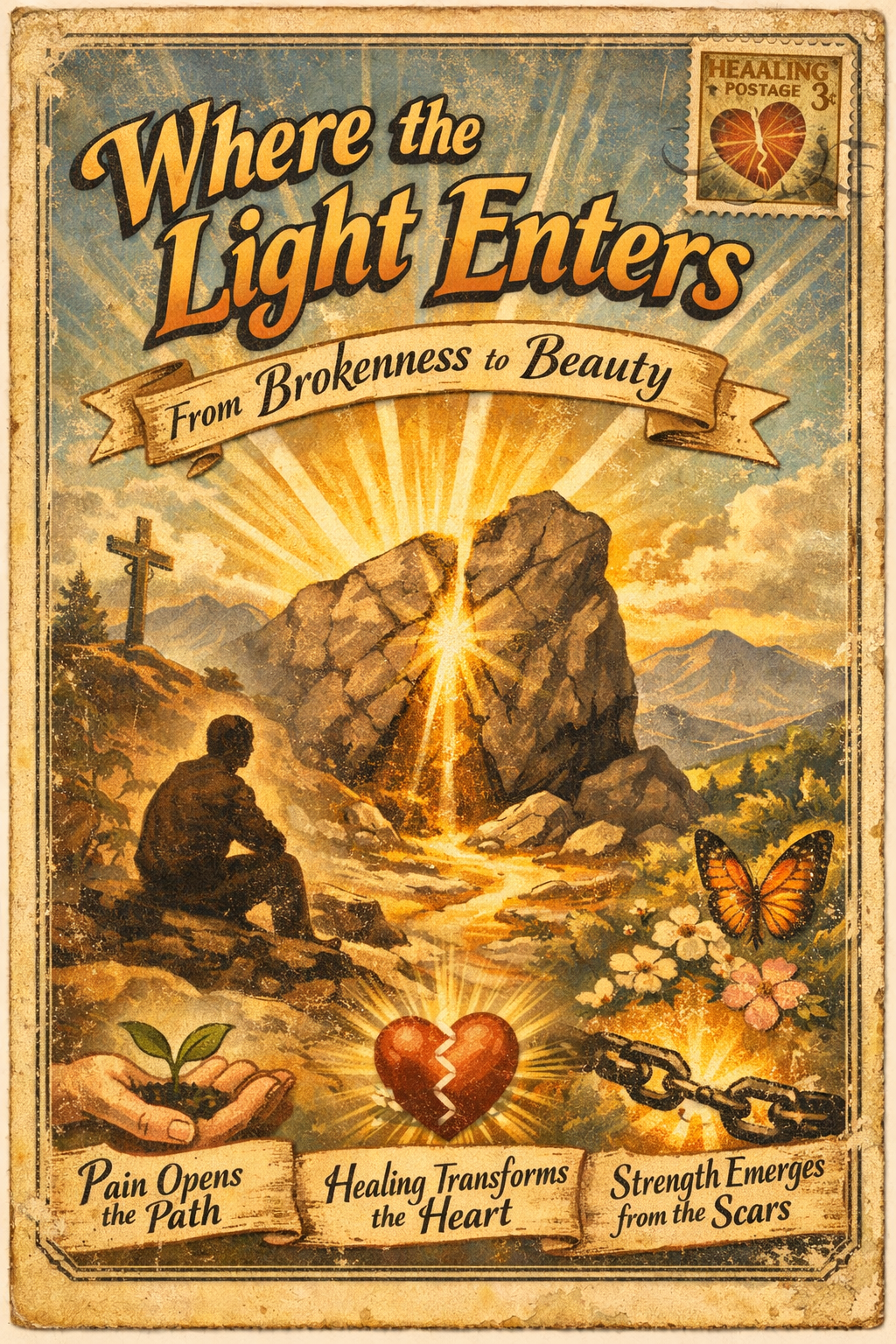
    Where the Light Enters

    1) Inspiration and Origin Story

    There is a quiet observation, passed. Down through poets, philosophers, and prophets alike over all history:

    The deepest wound is often where the brightest light shines through.

    At first glance, this feels contradictory—almost offensive to the experience of pain itself.
    How could something that hurts so deeply also become something meaningful to us?

    And yet, across cultures and time, the pattern repeats itself:

    • The broken become the compassionate.
    • The wounded become the wise.
    • The scar becomes the story that saves another.

    This is not romanticism. It is our transformation.


    2) Premise

    The premise is simple, yet not easy:

    Pain is not the end of your story—it is often the opening through which your greater self is formed.

    A wound does two things simultaneously:

    • It exposes vulnerability
    • It creates an opportunity for reconstruction

    And here is the crucial distinction:

    Pain alone does not transform us.
    Processed pain transforms us.

    Unexamined pain hardens us.
    Integrated pain illuminates us.


    3) Scriptural Foundation and Expansion

    2 Corinthians 12:9
    “My grace is sufficient for thee: for my strength is made perfect in weakness.”

    Strength is not built in the absence of weakness—it is revealed through it.

    Psalm 34:18
    “The Lord is nigh unto them that are of a broken heart.”

    Notice the proximity: not distant, but near.
    Brokenness does not repel God—it draws Him closer to us.

    Ether 12:27
    “I give unto men weakness that they may be humble… then will I make weak things become strong unto them.”

    Weakness is not a design flaw.
    It is a developmental mechanism.

    Here is the deeper pattern:

    God does not merely repair wounds—He repurposes them.


    4) Neuroscience and the Alchemy of Pain

    Now, let’s bring the lens of modern science into the conversation.

    When we experience emotional pain, the brain activates many of the same regions as those involved in physical pain—particularly the anterior cingulate cortex, which processes distress and conflict.

    Pain signals disruption.

    But the brain is not static. It is adaptive.

    Through a process called neuroplasticity (the brain’s ability to rewire itself), the following can occur:

    • Reflection and meaning-making strengthen the prefrontal cortex, improving emotional regulation
    • Reframing experiences reduces the reactivity of the amygdala (fear center)
    • Repeated exposure to healing narratives builds new neural pathways associated with resilience

    In plain language:

    When you face pain and assign it meaning, your brain literally rewires itself toward strength.

    This is why when two people can experience the same wound:

    • One becomes bitter
    • The other becomes luminous

    The difference is not the pain.
    The difference is the integration.


    5) Discussion — The Architecture of Transformation

    Let’s speak plainly.

    No one asks for the wound.

    No one signs up for the betrayal, the loss, the failure, the moment that cracks something open inside.

    But once it happens, you stand at a crossroads:

    • You can close around the wound
    • Or you can grow through it

    A wound, left unattended, becomes a wall.
    A wound, examined with courage, becomes a window.

    And through that window, light enters.

    Not because the pain was good…
    but because something greater was built in response to it.

    This is why those who have suffered deeply often carry a rare clarity:

    They see what matters.
    They feel what others miss.
    They speak with a weight that cannot be fabricated.

    They do not shine despite of the wound.

    They shine through it.


    6) Prayer

    Dear Heavenly Father,

    In moments of pain, help me resist the urge to close myself off.
    Teach me to trust that even in my brokenness, You are working with purpose in mind.

    Give me the courage to face what hurts,
    the wisdom to understand it,
    and the strength to grow through it.

    Let my wounds not become walls, but windows—
    places where Your light can enter and shine through me to others.

    Refine me, shape me, and use even my pain for something meaningful.

    In faith and surrender,
    I say this in the name of Jesus Christ, Amen.


    7) Call to Action

    Today, identify one past or present wound—not to relive it, but to reinterpret it.

    Write down:

    • What did it teach you
    • How it changed you
    • How it might help someone else

    Then take one small step: Share the lesson, not the pain.

    Because light multiplies when it is given away.


    8) Gratitude

    Be grateful not for the pain itself—
    But for the capacity within you to transform it.

    There is something within you that can take what was meant to break you…
    and use it to build you.


    9) Closing Thought

    A flawless surface reflects nothing.

    But a cracked one?
    It refracts light in ways that reveal hidden beauty.

    Your wound is not just a place of hurt.
    It is a place of passage.

    And if you allow it—

    It will become the very place where light learns how to shine through you.


    “Change does not begin with force — it starts with awareness, design, and alignment.” — Mark Huber

    Design a meaning from your pain. That is where your transformation begins.