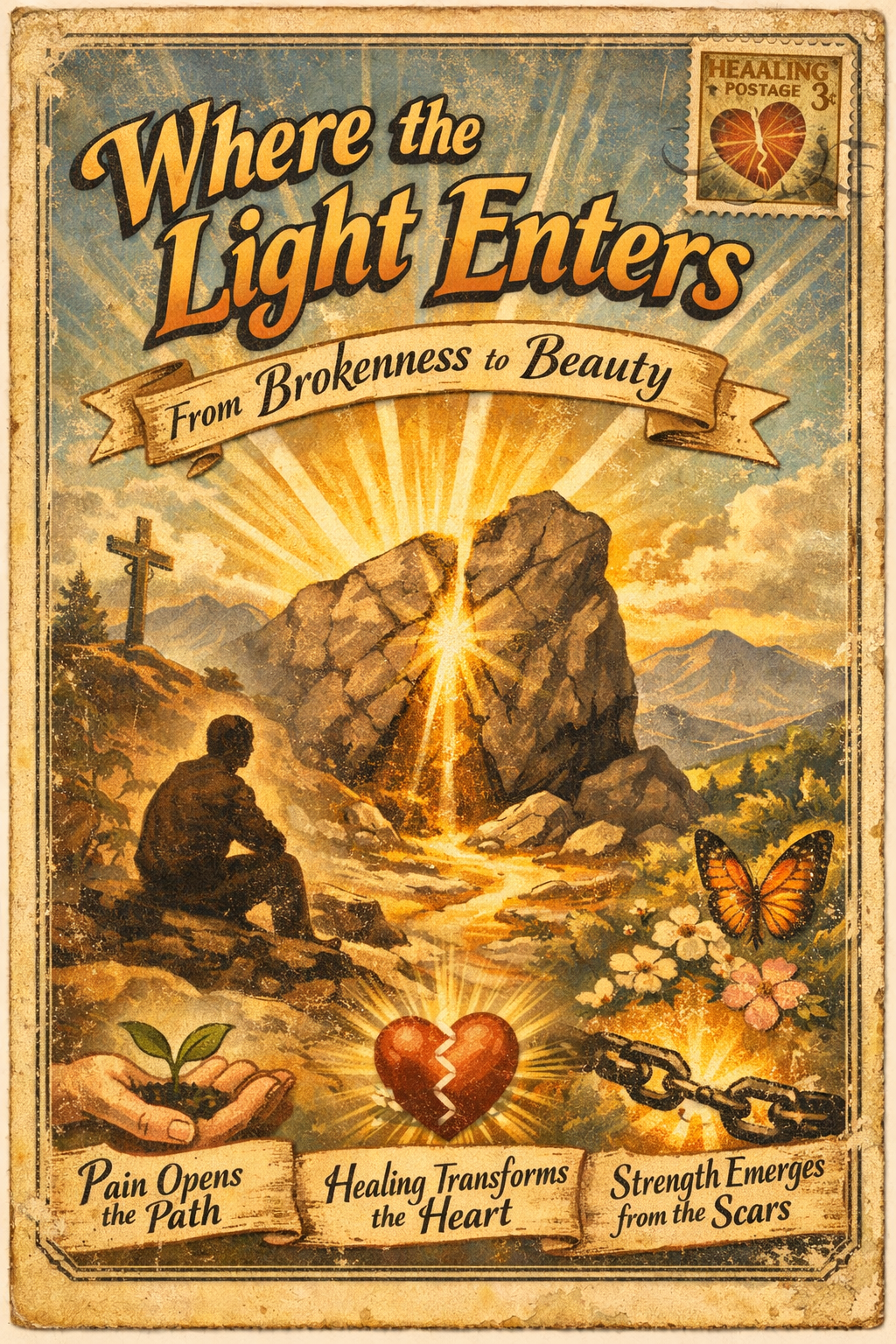
1) Inspiration and Origin Story
There is a quiet observation, passed. Down through poets, philosophers, and prophets alike over all history:
The deepest wound is often where the brightest light shines through.
At first glance, this feels contradictory—almost offensive to the experience of pain itself.
How could something that hurts so deeply also become something meaningful to us?
And yet, across cultures and time, the pattern repeats itself:
- The broken become the compassionate.
- The wounded become the wise.
- The scar becomes the story that saves another.
This is not romanticism. It is our transformation.
2) Premise
The premise is simple, yet not easy:
Pain is not the end of your story—it is often the opening through which your greater self is formed.
A wound does two things simultaneously:
- It exposes vulnerability
- It creates an opportunity for reconstruction
And here is the crucial distinction:
Pain alone does not transform us.
Processed pain transforms us.
Unexamined pain hardens us.
Integrated pain illuminates us.
3) Scriptural Foundation and Expansion
2 Corinthians 12:9
“My grace is sufficient for thee: for my strength is made perfect in weakness.”
Strength is not built in the absence of weakness—it is revealed through it.
Psalm 34:18
“The Lord is nigh unto them that are of a broken heart.”
Notice the proximity: not distant, but near.
Brokenness does not repel God—it draws Him closer to us.
Ether 12:27
“I give unto men weakness that they may be humble… then will I make weak things become strong unto them.”
Weakness is not a design flaw.
It is a developmental mechanism.
Here is the deeper pattern:
God does not merely repair wounds—He repurposes them.
4) Neuroscience and the Alchemy of Pain
Now, let’s bring the lens of modern science into the conversation.
When we experience emotional pain, the brain activates many of the same regions as those involved in physical pain—particularly the anterior cingulate cortex, which processes distress and conflict.
Pain signals disruption.
But the brain is not static. It is adaptive.
Through a process called neuroplasticity (the brain’s ability to rewire itself), the following can occur:
- Reflection and meaning-making strengthen the prefrontal cortex, improving emotional regulation
- Reframing experiences reduces the reactivity of the amygdala (fear center)
- Repeated exposure to healing narratives builds new neural pathways associated with resilience
In plain language:
When you face pain and assign it meaning, your brain literally rewires itself toward strength.
This is why when two people can experience the same wound:
- One becomes bitter
- The other becomes luminous
The difference is not the pain.
The difference is the integration.
5) Discussion — The Architecture of Transformation
Let’s speak plainly.
No one asks for the wound.
No one signs up for the betrayal, the loss, the failure, the moment that cracks something open inside.
But once it happens, you stand at a crossroads:
- You can close around the wound
- Or you can grow through it
A wound, left unattended, becomes a wall.
A wound, examined with courage, becomes a window.
And through that window, light enters.
Not because the pain was good…
but because something greater was built in response to it.
This is why those who have suffered deeply often carry a rare clarity:
They see what matters.
They feel what others miss.
They speak with a weight that cannot be fabricated.
They do not shine despite of the wound.
They shine through it.
6) Prayer
Dear Heavenly Father,
In moments of pain, help me resist the urge to close myself off.
Teach me to trust that even in my brokenness, You are working with purpose in mind.
Give me the courage to face what hurts,
the wisdom to understand it,
and the strength to grow through it.
Let my wounds not become walls, but windows—
places where Your light can enter and shine through me to others.
Refine me, shape me, and use even my pain for something meaningful.
In faith and surrender,
I say this in the name of Jesus Christ, Amen.
7) Call to Action
Today, identify one past or present wound—not to relive it, but to reinterpret it.
Write down:
- What did it teach you
- How it changed you
- How it might help someone else
Then take one small step: Share the lesson, not the pain.
Because light multiplies when it is given away.
8) Gratitude
Be grateful not for the pain itself—
But for the capacity within you to transform it.
There is something within you that can take what was meant to break you…
and use it to build you.
9) Closing Thought
A flawless surface reflects nothing.
But a cracked one?
It refracts light in ways that reveal hidden beauty.
Your wound is not just a place of hurt.
It is a place of passage.
And if you allow it—
It will become the very place where light learns how to shine through you.
“Change does not begin with force — it starts with awareness, design, and alignment.” — Mark Huber
Design a meaning from your pain. That is where your transformation begins.